8 Mindset Shifts To Help You Realise You Are Capable Of More
In partnership with Dr Tanya Hames
How often do you catch yourself saying something along the lines of I'm just not very good at that or that's not really for people like me? Most of us do it more often than we realise, but perhaps the more interesting question is: how do we know?
That's one of the ideas at the heart of Dr Tanya Hames' new book, You Are Capable Of More Than You Imagine. Tanya believes that many of the limitations we place on ourselves aren't necessarily facts at all. They can be beliefs and patterns we've picked up along the way, repeated so often that eventually we stop questioning them.
Her book brings together her academic background in mindset and motivation, her work as a clinical hypnotherapist and Rapid Transformational Therapy (RTT) therapist, and her experience in Feng Shui. The result is eight Perfect Mindset Codes, exploring how the way we think and behave can influence what we believe is possible.
And while we're not suggesting that reading this book will magically transform your life, we're not not saying that either. Yes, you still have to put in the work, but it could certainly help you think differently about what's possible.
1. RELEASE: What If Something You Believe About Yourself Isn't Actually True?
Tanya begins with a simple but surprisingly challenging premise: "Your beliefs are not facts."
The idea behind Release is that some of the things we accept as truths about ourselves may actually be stories we've carried for years. Perhaps you were always the shy one, the sensible one or the one who wasn't particularly academic. Whether someone actually said it or it simply became part of how you saw yourself, Tanya asks what happens when we start questioning those labels.
One example Tanya shares is of a successful international fashion model who still doubted her appearance because, as a child, her grandmother had described her as "the plain one". On paper, the adult reality and the childhood belief couldn't have been further apart, yet the old story still had power.
It's an interesting place to start, because once you begin questioning where some of your long-held beliefs came from, you may find yourself looking at them rather differently.
2. WORTH: Stop Waiting Until You Feel 'Good Enough'
How many opportunities do we quietly postpone until we've improved something about ourselves first? We tell ourselves we'll apply for the job when we're more confident or we’ll join the Pilates class once we've lost weight. Tanya describes Worth as building the belief that you are good enough, challenging that persistent feeling that we need to become something more before we're entitled to go after what we want.
This isn't about believing we have nothing left to learn or that preparation doesn't matter. It's about noticing when self-improvement becomes a condition we continually place between ourselves and our lives.
Because there will probably always be another reason to wait. At some point, perhaps good enough needs to actually be good enough.

3. LIBERATION: Question Your Own Invisible Ceiling
One of the stories that immediately caught our attention when Tanya talked us through the book was about Claire. At 62, Claire's youngest child had left university, her 27-year marriage had ended and an idea for a business she'd carried with her for years finally had room to surface. But instead of feeling excited, she felt embarrassed. Who starts a business at 62?
It's such a relatable example of what Tanya calls an "invisible ceiling": the assumptions we make about what somebody our age, in our circumstances or at our stage of life is supposed to do. Those unwritten rules can extend into almost every part of life, from deciding we're too old to change careers or start a business or believing we're too settled to move forwards.
Liberation isn't about pretending there are no practical constraints. It's about distinguishing between the constraints that genuinely exist and the ones we've created for ourselves. And there can be quite a difference between the two.
4. ABUNDANCE: Notice When You're Limiting What's Possible
This was another idea that stayed with us after speaking to Tanya. In the book, she tells the story of Nadia, a successful business owner who wanted to increase her prices but was absolutely certain her clients wouldn't pay more. When Tanya asked if she'd actually asked them, the answer was no. Nadia simply knew.
Tanya uses the example to explore the way an assumption can gradually become something we regard as fact. In Nadia's case, a belief about what her clients would pay was potentially limiting the business she could build.
Of course, an abundance mindset isn't a guarantee that everything will work out exactly as we'd like. Sometimes clients really won't pay more, but Nadia's story gives us something useful to think about when we're certain something isn't possible: do we actually know, or are we assuming?
5. IDENTITY: Who Do You Believe You Are?
We tend to think about change in terms of goals: run the 10K, get the promotion or become healthier. Tanya's Identity Code turns that around, asking us to think not only about what we want to achieve, but about the person we believe ourselves to be.
Someone who sees herself as active, for example, may naturally make lots of small choices consistent with being an active person. Someone who believes she has something worthwhile to contribute may behave very differently in a meeting from someone whose internal narrative is nobody really wants to hear what I think.
Seen that way, change doesn't always have to be about trying harder. It can also be about whether the picture you hold of yourself fits the person you want to become.

6. PRESENCE: Think About What You Bring Into The Room
We tend to think about the atmosphere of a room as something we're walking into. Tanya asks us to consider what we're bringing with us.
In one of the book's examples, she describes working on the Feng Shui of a home and gradually changing the space, only to realise that the environment was just one part of what she was observing. She compares our presence to Guernsey weather - being an island, it catches whatever comes in off the Atlantic - suggesting that every person carries an "internal climate" into the spaces they enter.
You don't necessarily have to think about that in terms of energy to recognise the experience. We know what it's like when someone walks into a room visibly stressed and everybody feels it, or when someone's calmness seems to settle everyone around them.
Before the next meeting, family dinner or difficult conversation, it might be interesting to think about not only what you're going to say, but what you're bringing into the room with you.
7. EXPRESSION: Dress For Yourself First
This one might sound superficial, but it isn't intended to be. It explores the connection between what we wear and how we feel, with the emphasis less on impressing other people and more on the message we send to ourselves. As she puts it: "You are your own first audience."
One of her examples comes from a trip to Venice, when she deliberately dressed in a way that felt worthy of the occasion. She describes standing taller and feeling completely herself as a result. Her point isn't that we all need better clothes. It's not about money or taste, but intention: wearing the perfume instead of saving it, putting on the outfit you love and questioning why we're keeping our good things for an unspecified occasion important enough to deserve them.
Perhaps an ordinary Monday is occasion enough.
8. SANCTUARY: Make Your Environment Work For You
Tanya has spent years working with homes through her Feng Shui business Perfect Sanctuary, so it's perhaps unsurprising that the final Code looks at our physical surroundings.
She contrasts an expensive house where the owners barely used their beautiful surroundings with a student's tiny bedsit that had been thoughtfully turned into what Tanya describes as a little "jewel box". Her point is that creating a sanctuary isn't about having the biggest home or the biggest budget.
So look around the spaces where you spend most of your time and think about whether they're making the things you want to do easier or harder. If you want to read more, is there somewhere inviting to sit? If you're working from home, does your workspace allow you to concentrate?
Sometimes changing what's around us can be easier than trying to summon more willpower.
From Imagining To Action
There's a thread running through all eight Perfect Mindset Codes that we particularly like: understanding something about ourselves isn't quite the same as doing something with that understanding.
Tanya calls the final stage of the book imagining in action, moving from recognising beliefs and patterns towards the choices we make about how we show up, what we wear and the environments we create. You may recognise yourself immediately in one of the eight, disagree with another, or find one that simply makes you stop and think. You certainly don't have to tackle them all at once.
Perhaps it's enough to start by wondering: what might be possible if I stopped assuming it wasn't?
Join Us For The Official Book Launch
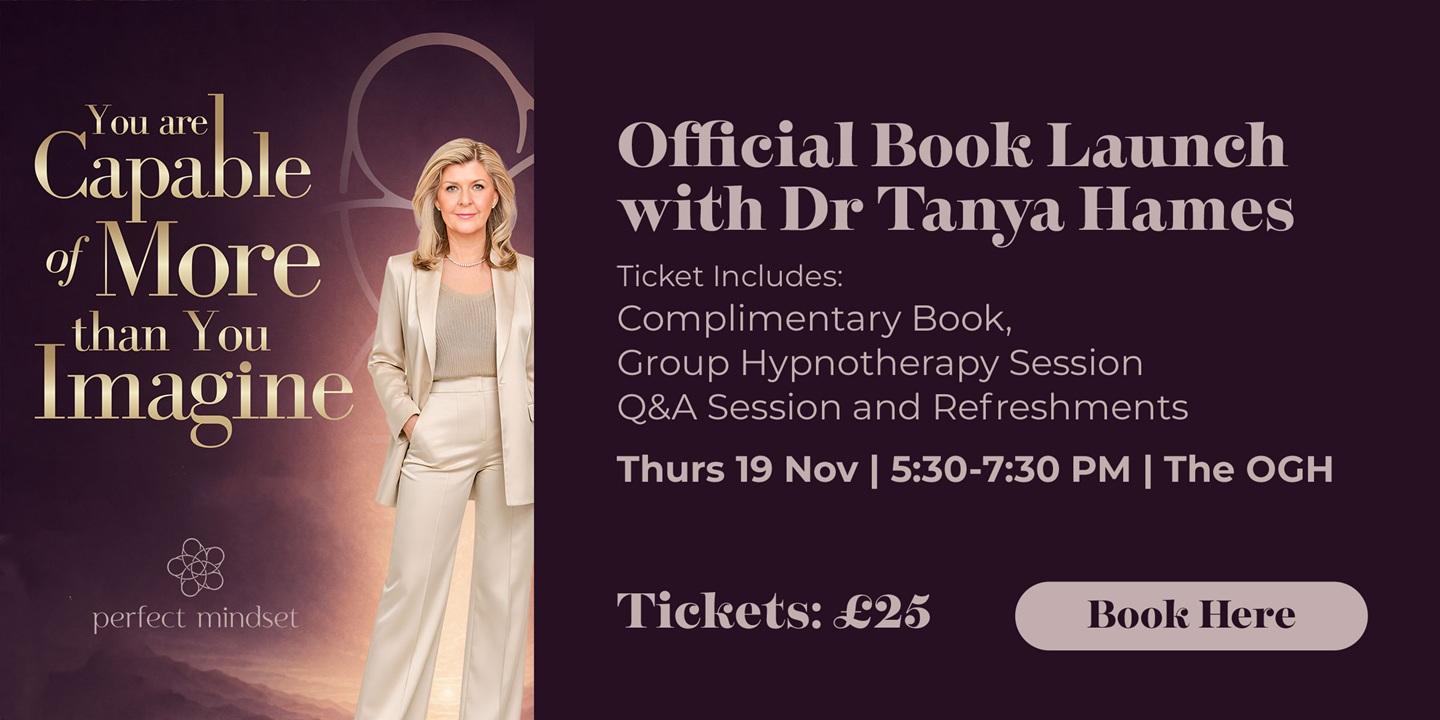
If you'd like to explore the Perfect Mindset Codes further, Dr Tanya Hames is launching You Are Capable Of More Than You Imagine at The OGH on Thursday 19 November, from 5.30pm to 7.30pm.
The evening will introduce the book and the eight Perfect Mindset Codes, with the opportunity to hear directly from Tanya, ask questions and experience her 'Being Capable of More' group hypnotherapy session.
Tickets are £25 and include a complimentary hardback copy of her book, worth £20.99, healthy drinks and snacks, the group hypnotherapy session and the opportunity to have your copy personally signed by Tanya.
Book your place here
About Dr Tanya Hames
Dr Tanya Hames brings together an academic background in mindset and motivation with her work in hypnotherapy, Rapid Transformational Therapy and Feng Shui.
After a career of around 20 years in education, Tanya completed a doctorate at Durham University specialising in mindset and motivation and presented her research at international conferences. She later trained in hypnotherapy with Marisa Peer and founded Perfect Mindset, alongside her established Feng Shui business, Perfect Sanctuary.
Tanya is registered with the General Hypnotherapy Register, General Hypnotherapy Standards Council and International Association of Counsellors and Therapists. She also holds advanced Feng Shui accreditations and serves on the International Board of the International Feng Shui Guild.
You Are Capable Of More Than You Imagine brings these different strands of her work together in one practical framework.

Get content on wellbeing and local life straight to your inbox
We think you'll like these articles too...



LIVE LIFE WELL. LOVE LOCAL. LOVE THE LIST.
LIVE LIFE WELL.
LOVE LOCAL.
LOVE THE LIST.
Get content on wellbeing and local life straight to your inbox
© 2026 The List Limited. All Rights Reserved.